Anatomy of a Couture Banquette: Channel, Tufted, Piped and Quilted Backs Explained (2026)
Channel vs biscuit vs diamond tufting, welts and piping, brass inlays and millwork end caps: how a luxury restaurant banquette is built and specified.
Short answer: A couture banquette is defined by four things: the back construction (channel, biscuit, diamond-tufted, quilted or plain), the edge detail (welt or piping), the metalwork and millwork that frame it (brass inlays, capping rails, end caps, plinths) and the precision with which all of these are set out to the room's exact dimensions. For restaurant use, buttonless channel and biscuit backs are the most practical; deep buttoning belongs on backs and end faces, not seats.
This guide breaks a banquette down layer by layer, from frame to finish, with the vocabulary designers and upholsterers use, so you can specify one precisely and judge a shop drawing when it arrives.
What is a banquette, exactly?
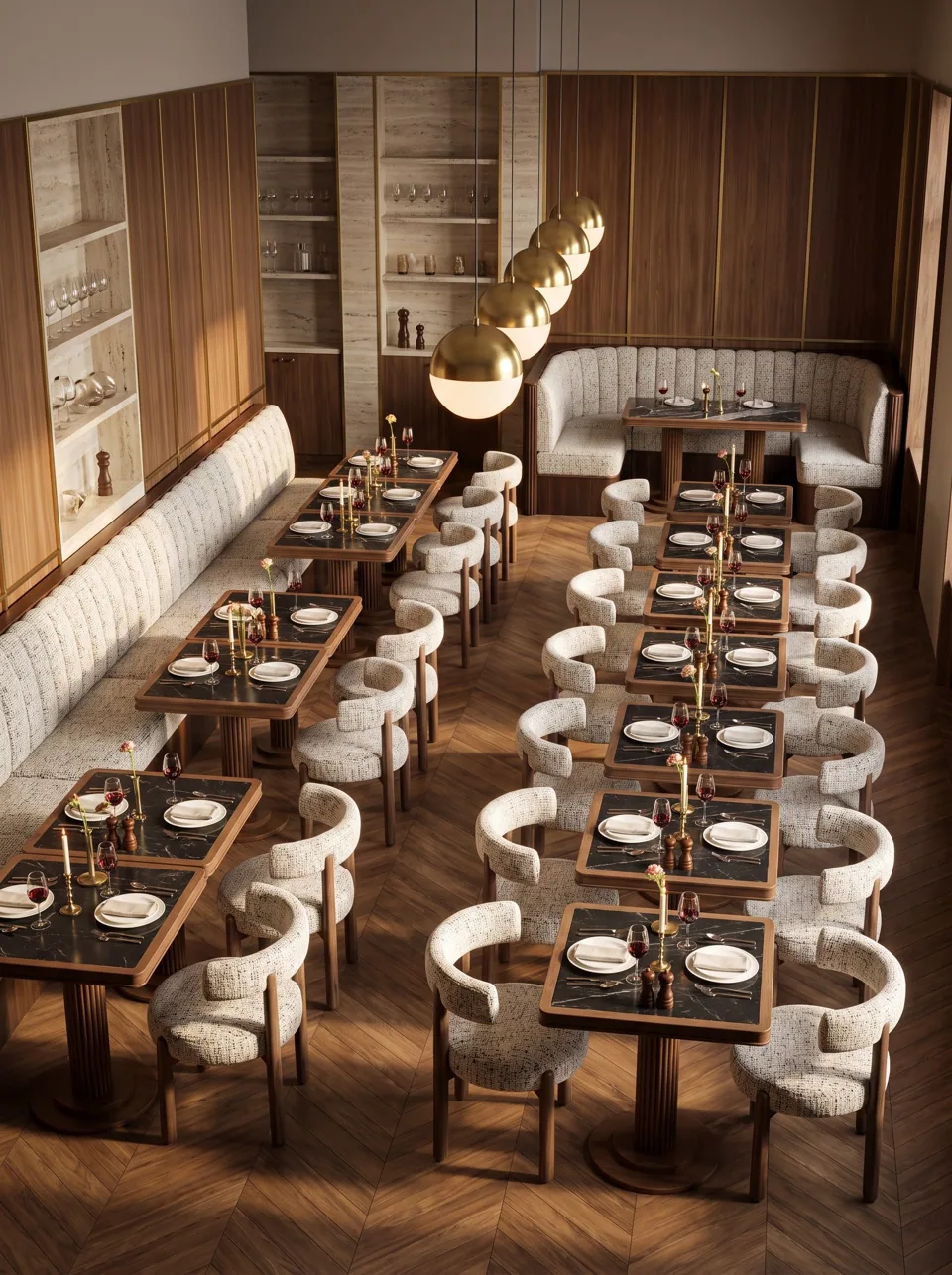
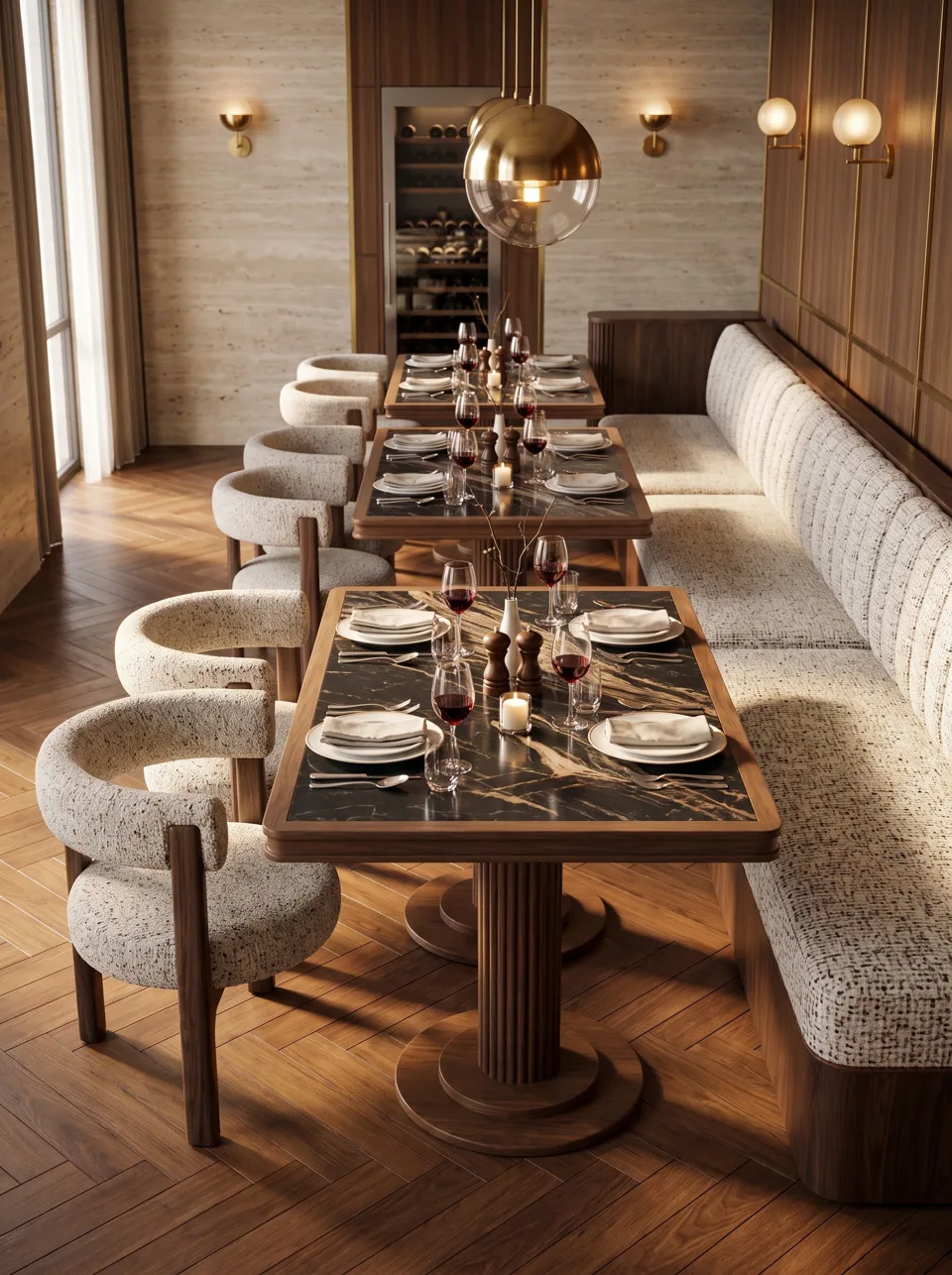
A banquette is a long upholstered bench seat, usually set against a wall or back-to-back in the middle of a room, served by a row of freestanding tables with chairs on the open side. A booth is a banquette arrangement that encloses a table on two or three sides. A couture banquette is one where the upholstery and detailing are drawn specifically for the room: stitch lines set out to the run length, welts in chosen colours, trims aligned with the architecture.
The difference between a good and a mediocre banquette is rarely the fabric. It is whether the channels finish evenly at both ends, whether the welt runs straight for three metres, whether the brass strip meets the timber cap on a single line.
The layers, from the floor up
| Layer | What it is | What to specify |
|---|---|---|
| Plinth (base) | The timber or metal base the seat sits on, usually set back 5–10 cm | Height (typically 8–15 cm), set-back, timber species and finish, brass kick strip or foot rail |
| Seat deck | Platform supporting the seat cushion | Plywood with sinuous springs or elastic webbing |
| Seat cushion | Foam and wrap on the deck | Foam density and firmness, fire specification, fixed or loose |
| Back frame | Timber structure of the back | Height, rake (typically 8–15° from vertical), profile of crest |
| Back upholstery | Foam, stitching pattern and cover | Channel, biscuit, tufted, quilted or plain; channel width; covering |
| Edge detail | Welt/piping along edges | Self or contrast colour, size (typically 6–10 mm), leather or fabric |
| Capping and trims | Timber rail on top, brass inlays, edge guards | Material, profile, finish (lacquered, PVD, unlacquered brass) |
| End cap | The short exposed face of the run | Upholstered, timber, brass-edged, sculpted |
Underneath it all, a commercial banquette needs a kiln-dried hardwood and plywood frame, joined with glue blocks, screws or bolts rather than staples alone, and foam specified to the fire rules of the destination market (see our upholstery guide for the detail on BS 5852 and CAL TB 117-2013).
Channel, biscuit, diamond or quilted: which back?
Channel back
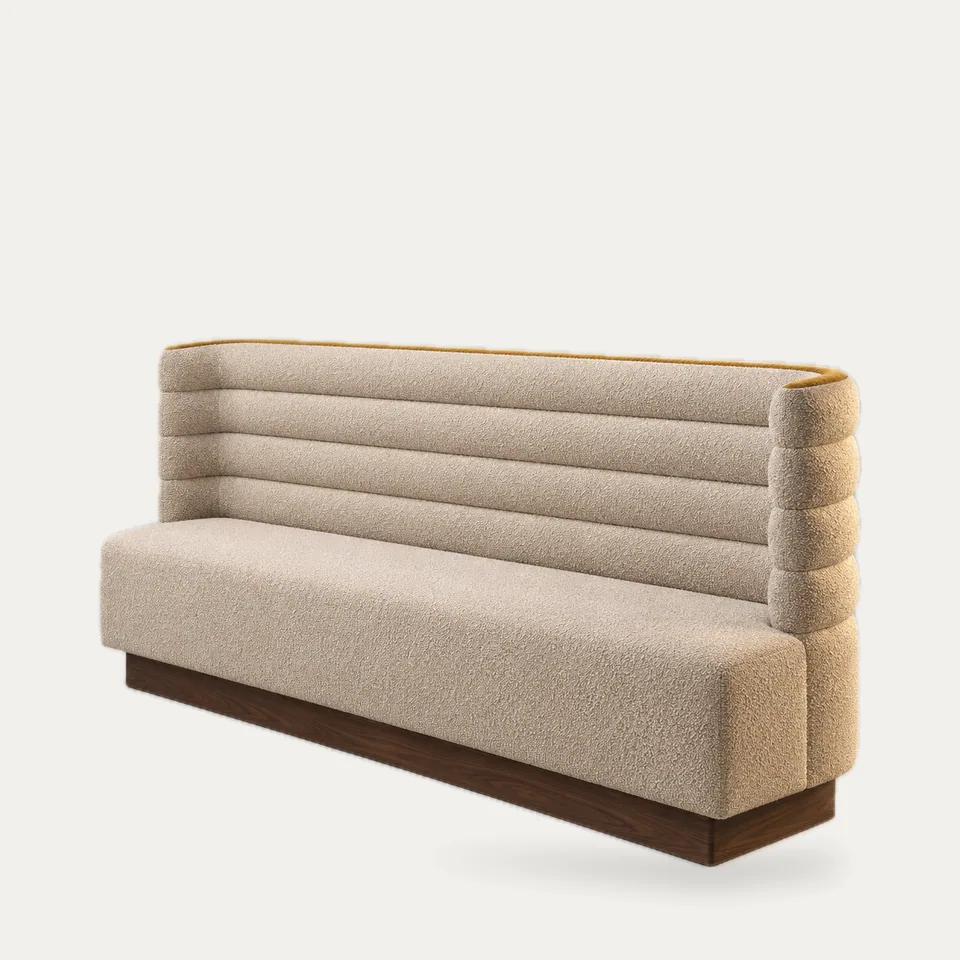
Channel tufting divides the back into parallel stuffed columns (vertical channels) or rows (horizontal channels), separated by sewn lines that pull the cover down to the frame. Each channel is filled with its own strip of foam, so it stands proud.
- Vertical channels emphasise height and suit booths and high backs. Typical widths run from 8 to 15 cm.
- Horizontal channels emphasise length and widen a wall; they suit long runs. Our Ribbon Horizontal Channel Banquette uses channels about 10 cm deep.
Channels must be set out so they finish evenly. If a back has 60 cm of upholstered height above the seat cushion, six 10 cm horizontal channels fit exactly; on a 240 cm run of vertical channels, 12 cm channels give twenty equal columns, whereas 14 cm channels would leave an awkward 2 cm remainder. This is drawn, not improvised.
Biscuit back
Biscuit tufting is a grid of square or rectangular pads, again created by sewn lines rather than buttons. It gives the depth of a tufted back without button wells, so it is easier to clean and does not lose buttons. It is the classic American steakhouse and diner back, and in caramel or oxblood leather it reads as club rather than diner. See the Caramel Biscuit Leather Banquette.
Diamond (Chesterfield) tufting
Diamond tufting uses buttons pulled deep into the foam, with the cover folded into pleats between them to form diamonds. It is the most traditional and most luxurious-looking finish, but in a restaurant each button well collects crumbs and the buttons themselves are a maintenance item. Our recommendation: use it on backs and especially on end faces, where nobody sits, and keep seats plain.
Quilted and embossed backs
Quilting stitches the cover through a layer of wadding in a pattern (diamonds, lines, scallops), giving a flatter, softer texture than channels. Embossing presses a pattern into leather with a heated die, giving texture with a continuous, wipe-clean surface. Embossing requires a die, so it suits project quantities.
Comparison
| Back | Depth of relief | Cleaning in service | Labour | Best use |
|---|---|---|---|---|
| Plain (tight back) | None | Easiest | Lowest | Minimal rooms, budget-conscious runs |
| Horizontal channel | Medium–high | Easy | Medium | Long runs, hotel dining |
| Vertical channel | Medium–high | Easy | Medium | Booths, high backs |
| Biscuit | Medium | Easy | Medium–high | Grills, brasseries |
| Quilted | Low | Easy | Medium | Soft, modern rooms |
| Embossed leather | Low | Very easy | Die cost plus low labour | Private dining, lounges |
| Diamond tufted | High | Hardest | Highest | Backs and end faces only |
Welt, piping and cord: the edge details
A welt (in the US) or piping (in the UK) is a cord wrapped in a strip of fabric or leather and sewn into a seam, giving a crisp, defined edge. Terms overlap; in practice:
- Self welt uses the same material as the cover and simply sharpens the edge.
- Contrast welt uses a different colour or material (for example cognac leather on green wool) and draws the outline of the banquette.
- Double welt places two cords side by side, often used to finish the bottom edge where upholstery meets a frame.
- Flanged or French seam has no cord and gives a softer, tailored edge.
Welts are usually 6–10 mm in diameter. The craft lies in keeping them straight over long runs and unbroken round curves; a welt that kinks at a corner is visible from across the room.
Brass and millwork: where couture meets joinery
The details that make a banquette read as fine dining are often not upholstery at all.
- Timber capping rail: a solid timber rail along the top of the back protects the edge that staff and guests grip, and frames the upholstery. Walnut and oak are the usual choices.
- Brass inlay strips: 1–2 cm brushed-brass strips set flush between upholstered tiers, as on the Sunburst Deco Banquette.
- Edge guards: continuous brass profiles around exposed ends, which protect against impact.
- Foot rails and kick strips: brass rails at the base protect the plinth from shoes.
- Mouldings and pilasters: stepped timber mouldings and fluted pilasters for neoclassical rooms.
For brass that will be handled nightly, specify PVD-coated brass for a stable finish, lacquered brass for a bright finish that will eventually wear, or unlacquered brass if you want a living patina.
End caps: finishing the run
The end of a run faces the aisle, and it is both the most visible and the most abused part of a banquette. Options range from a plain square end (best against walls and for joining sections) to wraparound channels that flow round a radius, brass edge guards, fluted contrasting faces and deep-buttoned leather ends. Specify which ends are exposed on the plan; a square end against a wall and a sculpted end at the aisle is a common and sensible combination.
How to specify a couture banquette: checklist
- Run lengths and joints: give exact wall dimensions and note doors, columns and radiators. Decide where section joints fall.
- Seat height and depth: 46 cm seat height for 74–76 cm tables; 50–56 cm seat depth for dining.
- Back height and rake: 107 cm is the typical overall height; 85–95 cm for open rooms; 115–150 cm for privacy.
- Back construction: channel (orientation and width), biscuit (grid size), tufted, quilted or plain.
- Welt: self or contrast, material and size.
- Covering: fabric, velvet, wool or leather; rub rating; fire performance; COM/COL quantities.
- Trims: capping rail, brass inlays, edge guards, foot rail, finish.
- End caps: which ends, which style.
- Plinth: height, set-back, material.
- Sample: stitch mock-up or full section before production.
Common mistakes
- Leaving channel set-out to the workshop. If the drawing does not show channel widths across the actual run, you risk a narrow leftover channel at one end.
- Buttoning the seat. Deep buttons on seats trap food, pull out and are uncomfortable. Keep buttons on backs and ends.
- Specifying unlacquered brass and expecting it to stay bright. It will darken unevenly where hands touch it.
- Ignoring the plinth. A flush plinth gets scuffed by every shoe and mop; set it back.
- Forgetting the back rake. A bolt-upright back looks crisp in a render but is uncomfortable within twenty minutes.
- Approving from a render alone. A physical sample is the only reliable way to sign off foam firmness and welt colour.
FAQ
What is the difference between channel tufting and tufting?
Channel tufting creates continuous parallel channels with sewn lines and no buttons. "Tufting" usually refers to button tufting, where buttons pull the cover into the foam to form diamonds or squares. Channel tufting is more practical for restaurants because it has no button wells.
Is piping the same as welting?
Effectively yes. "Piping" is the common British term and "welt" or "welting" the American term for a fabric- or leather-covered cord sewn into a seam to define an edge.
How wide should banquette channels be?
Most restaurant channels are 8–15 cm wide. Narrower channels look finer and more formal; wider channels look softer and more relaxed. The right width is the one that divides evenly into your run length or back height.
Can I mix materials on one banquette?
Yes. Contrasting end faces, two-tone backs and banded backs are common. Each change of material needs a seam, usually finished with a welt or a brass strip, and should be drawn on the shop drawing.
Which back is most durable in a busy restaurant?
A plain or channel back in a tight-woven fabric or commercial leather, with a timber capping rail protecting the top edge, will outlast more decorative backs. Embossed leather is also very durable because it has no seams on the face.
Send us a floor plan, elevation or sketch with approximate run lengths and the look you have in mind. We will reply with questions or an itemised quote and a drawing schedule.
Request a quote